Showing posts with label history. Show all posts

Thursday, November 5, 2015

AMFF Featured in This is Fly Magazine

Check out Communication Coordinator Pete Nardini's article On the Fly With: Rick Porcello: Red Sox in Fly Fishing Past and Present. The article takes the reader through Rick Porcello's fly fishing journey and compares it to some of the Red Sox's all-time greats along the way.

http://www.thisisfly.com


Catch the AMFF's video interview with Rick Porcello on Youtube and Vimeo.


Wednesday, September 2, 2015

Fly Fishing History Makers: Bill Oyster


Bill tames a healthy rainbow with his Oyster Bamboo rod

The first time that Bill Oyster witnessed fly fishing was while growing up in the northwestern town of Powell, Wyoming. Ironically, it wasn’t until Bill moved to the warmer climate of north Georgia that the obsession really stuck. Bill would often hike for many miles and camp alone along the crystal clear trout streams of the Appalachian wilderness. With trout in the back yard, Bill soon discovered that it was a half day drive to the Gulf of Mexico or the Atlantic to pursue, sea trout, redfish, and tarpon. In other words… this area had virtually no limit to keep entertained even the most enthusiastic fly fisher on a year round basis. While attending the University of Georgia in Athens, Bill met his wife Shannen who would be a large part of his success at turning his passion into a career. Soon after leaving college to compete as a professional road racing cyclist, Bill and Shannen were married and moved to Gainesville, GA. Just after the ’96 Olympic Trials Bill suffered a career ending fall while training. Suddenly he had time and energy to spare and poured it all into his fly fishing interests. He spent time doing anything he could in the fly fishing world from tying flies at the trade shows to teaching casting and guiding for area fly shops. 


Still in his twenties, he soon took an interest in bamboo fly rods.  He loved the beauty and history and hoped to obtain one for himself. The more he learned about these rods, the more he became intrigued by the craft itself. At that time there was no one around to mentor his interest in rodmaking and no internet with its endless stream of information. So it was through a small stack of dusty books and countless hours of trial and error that Bill slowly put together his own style of employing these traditional techniques. Each rod produced was a bit better than the one before, and his experience in all manner of fly fishing (as well as his casting knowledge and abilities), quickly put him on the road to creating classic rods that could satisfy a more modern expectation of performance. His art training led to an aesthetic that set a new standard for the kind of beauty that could be achieved in the most high-end niche of the market. 

Many hours are spent at the engraving vise creating his hyper customized rods for clients from around the world. When he’s not crafting rods for customers, he shares his craft through the Oyster rodmaking school. Drawing on his own experience and struggles with all techniques and methods of rod construction, he has created what is by far the largest school of rodmaking in the world today. Each year over a hundred students travel from around the world to spend a week with Bill completing their own rod using the very same techniques employed on every Oyster rod. When not working, Bill often leads groups of his clients on fishing expeditions where they put their creations to the test in some of the most exotic and beautiful destinations in the world.  These days Bill and his wife run their production shop and rodmaking school in the quaint north Georgia mountain town of Blue Ridge, where they live with their two small children Cutter and Veronica.  

Bill and family at home on the river

Q & A With Bill Oyster:


What were your beginnings in fly fishing? Who got you into it?
Its really just something I stumbled into on my own.  Nobody in my family had any interest in fishing, but I was captivated by it from my earliest memory.  I first saw fly fishing as a kid growing up in northwest Wyoming.  At the time I wasn't too impressed as my Zebco and can of worms seemed to do the trick just fine.  It wasn't until college when I picked up a fly rod to chase the trout in north Georgia that I was really struck by, not just how effective it was (and not very at first), but how beautiful it was as well.

Why bamboo?
I have always had what you might call an artistic sensibility.  The romance of a bamboo rod, a wooden sailboat, or classic motorcycle - it's not something you can explain, and certainly not something you can justify.   It's just either something that stirs your senses, or it isn't.  For me it was, and still is.

Are there any rod makers that have influenced your technique?
For me it was every rod maker who ever wrote a book.  I've read them all many times over.  I think that Everett Garrison's book might have to top the list.  It made the whole process seem like such a serious and impossible undertaking that I just had to give it a try!

What do you do differently than everyone else?
Strangely, I think the biggest difference between me and other rod makers is that I don't take it too seriously.  Fly fishing and fly rods should be fun.  Yes, I am serious about always trying to make the finest fly rods I can, because to me that IS fun.  I don't mind if others like different styles or use different methods.  I'm not interested in debating tapers or plane sharpening angles.  I know what works for me and enjoy every minute of it.

How did you learn to engrave and what goes into that process?
Early on I experienced a demand from my customers for personalization.  I took a chance on myself and travelled to an engraving school in Kansas to see if it was something I might be able to do.  Fortunately, it stuck.  I talk directly to the customer and combine their interests and history with my experience to design and create the custom engravings.  I sometimes spend upwards of a hundred hours designing, drawing, and cutting the most elaborate pieces.

A few fine examples of Bill's engraving prowess


What is the creative process that you go through when making fly rods?
It all starts with the customer.  I need to know how and where they will use the rod.  Also, if they have any strong preferences in rod action or feel.  All of the practical considerations come first.  Only then do we discuss aesthetics.  First and foremost the rod must perform properly, consistently, and reliably.  Otherwise I might as well just paint them a picture instead!  Some are only looking for a simple and understated style, and we are happy to comply. Many of our more complicated rods are ordered as heirloom pieces and my engravings are based on highly personal ideas that will stay in that family for generations.

What was your favorite fly rod that you have made?
There is no question that it is the first rod I ever made #001.  It took me six months of trial and error, reading and re-reading, head scratching and cussing, but I finally achieved something I had dreamed about for years.  I'll never sell this rod.  It's MY family heirloom.

What was it like fishing with and making a rod for President Carter?
I guided Pres. Carter again last week, and it's always the same - highly rewarding, thoroughly enjoyable, and more than a little stressful.  He is after all a serious dry-fly man, and those big boys aren't always looking up on demand.  He's a hell of an angler though, and we always get a few to the net.  The rods were originally purchased as a fundraiser by the Carter Center.  The idea they had was that he would autograph it before I varnished it, he would fish it for awhile, then it would go to auction as a fundraiser.  However, after fishing the first rod for about thirty minutes, he decided that a new rod should be commissioned because that one wasn't going anywhere!  It was a real honor for a young guy from a one red light town working all alone (at that time) in his basement!

Were there any challenges or adversity you had to overcome?
Well, starting out as a twenty something year old kid in the Deep South didn't really help me fit the stereotype for a bamboo rod maker.  None of the "big" guys in the industry really gave me the time of day back then.  That's when I decided that I wouldn't spend too much time worrying what others thought of me.  Instead I set out to make rods that were so fine, worked so well, and looked so good that it didn't matter who made them, or where.  That still pretty much sums up our business philosophy, although with the grey beard things are getting easier!  In fact, all of the closed doors I experienced when starting out is what lead me to teaching rod making classes.  I found that rejecting the enthusiasm of would-be rod makers just plain felt bad.  That wasn't the feeling I wanted mixed up in my life's work.  Instead, I decided to find a practical way to make people feel good.  To this day I've helped more people complete their first bamboo rod than anyone in history, and that makes ME feel good.  See how that works?
Busy at work at the Oyster rod shop


What is your favorite fish to go after - do you prefer chasing hard to find fish and experiencing the different places you catch them in or staying local and going after the football rainbows in Georgia?
I will fish wherever I have the opportunity, and have certainly spent my share of time harassing the local trout.  However, like any drug, a real junkie always needs more.  This year alone I've fished for trout and stripers in Ga, bull reds in Louisiana, big Browns in Patagonia and tarpon in the Keys.  Next month I'll be heading to northern Argentina for golden dorado, and in November it's Andros Island for bonefish.  I am an addict through and through.  

Any special memories from the rod shop or people you encountered?
The shop is my home, where I sleep is less important.  Employees, friends, and fishing buddies are one in the same.  My wife handles the business end of things from her office, my kids do their homework sitting in bamboo shavings, our dogs sniff everyone who walks in.  This is where we hang out on our days off, and meet up when we go out.  This place and the people that frequent it are what allows us all to live the life we want.

Have you taught your kids to fly fish or have they shown interest in picking up the rod building torch?
My kids enjoy fishing like most kids naturally do when given the chance.  I am careful not to push them too much, since I don't want to chase them away.  I would love it if they choose to carry the torch someday, but only time will tell.

What are your thoughts on fisheries conservation?
I've seen first hand the effects of development, deforestation, pollution and overcrowded waters.  It's a problem we've all created and must find a way to manage.  Mother Nature simply can't keep up if we continue in a thoughtless and careless manner.  Still there are those (fisherman even!) who act like there's no tomorrow and take without giving.  It's a problem for sure, but one that could be managed if enough people would stop thinking about their tomorrow and instead think about their children's.  Rant over...

Bill puts the Oyster 9 wt. taper to the test in Big Pine Key
Ok. One rod, one reel, one fly and you’re on a deserted island. What do you take?

Hmmm, an island, must be saltwater, gonna need to eat... 8'9wt Oyster bamboo (solid built for durability) with my trusty Tibor Signature Series reel, and a good old Clouser Minnow.  Let's go fishing!

Thursday, May 21, 2015

What a President brings to the River: A look inside Calvin Coolidge's Tackle Box

by Peter Nardini


Calvin Coolidge with his catch of the day


This past week we said goodbye to some of our favorite items on display in our Leigh Perkins Gallery, returning Calvin Coolidge’s fly tackle to the Calvin Coolidge State Historical Site in Plymouth Notch, Vermont. During the 1970s (and again in the 1990s), the site received a donation of a wooden packing crate full of Coolidge’s fly-fishing equipment. The staff made note of the contribution and intended to catalog the collection after buildings were renovated and exhibitions were installed. In the fall of 2010, after successfully opening a new visitor center, the site’s regional historic site administrator, Bill Jenney, contacted the American Museum of Fly Fishing for help with the identification of that fly-fishing collection. Yoshi Akiyama, deputy director, was called into service.

After several visits to the President Calvin Coolidge State Historic Site to unpack and identify the collection, Yoshi was able to witness firsthand the largest known fly-fishing collection belonging to President Calvin Coolidge. The collection includes several hundred trout flies, six bamboo rods, some leather fly boxes, and a few bait- and fly-casting reels. (Coolidge took a lot of flak from fly-fishing enthusiasts when he commented to the press that he would periodically use worms to catch trout.) None of the fly tiers can be identified, but it appears that some flies were store bought and some may have been tied specifically for the president.


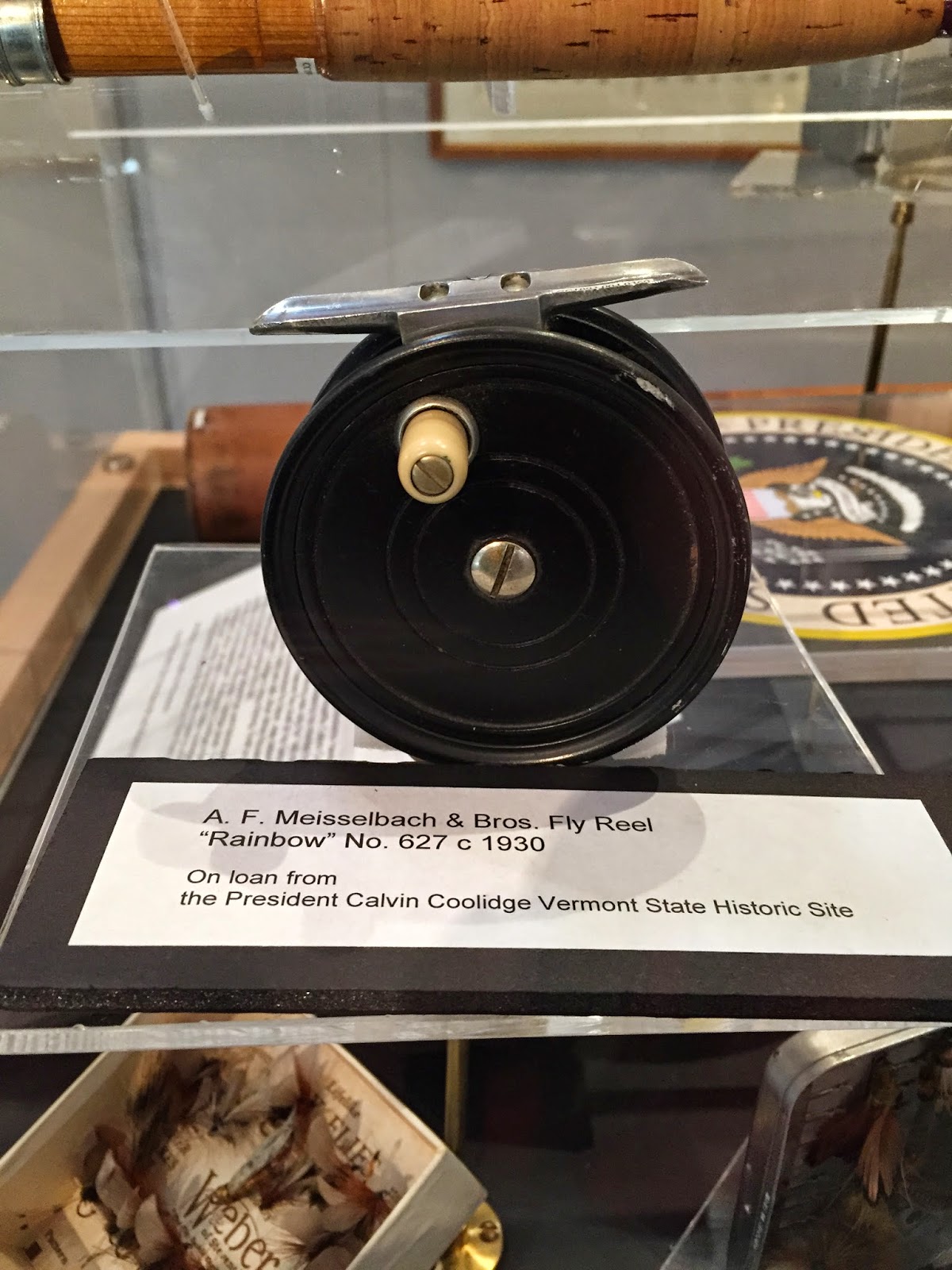
We were fortunate enough to have a few of those items on display at the AMFF as part of our Wonders of Fly Fishing exhibition until last week. I helped Yoshi inventory and inspect the equipment and carefully wrapped it up for safe transport back to Plymouth, my hands shaking at the thought of being as close as I would probably ever come to a President or anything belonging to one. Among the first items laid out on the table were two Meisselbach reels owned by President Coolidge. Of all the items in the collection, these reels showed the most significant signs of wear. These were not simply thrown into the usual pile of unused gifts of state - the black finish on one reel in particular was chipped off in multiple places, an impressive feat considering that the President only used it for anywhere from 5 to 7 years. Calvin Coolidge had been a lifelong angler and picked up fly fishing in 1926 during a summer trip to the Adirondacks. By the time he vacationed in the Black Hills of South Dakota in 1928 (for three months!) it had become a full-time obsession. His Secret Service Chief and Presidential Fishing Buddy, Edmund Starling, was a fly fishing enthusiast and hedged his bet that he would make President Coolidge a fly fisherman by making sure ahead of time that all of the places the President would be fishing were stocked full of trout. After duping stocked rainbows and taking fishing lessons, Calvin Coolidge had the fever, spending most of his presidential vacations fishing at many locations across the country – from Maine to Georgia and back again. In fact, in an excerpt from Grace Coolidge’s memoirs she writes: “Enthusiasm for the sport had so taken hold of him that at the close of the fishing season he was reluctant to give it up. He scanned the New York State fish and game laws and learned that while fishing was not permitted in the county in which we were living after the first of September, it was not prohibited in the adjoining county until Labor Day, a fact which was not known to the guide or to the caretaker of the camp, himself an ardent sportsman.” If Calvin Coolidge set out to catch a fish he was going to do so, not sacrificing his chance of success on the idea that fishing only with a fly rod was considered the “pure” way. In politics he was similarly removed of all pretense or snobbery, stepping up and providing the country with a stabilizing presence after President Warren Harding died in office then picking up and moving on despite calls for him to run for President. The allure of the Oval Office did not get to Calvin Coolidge.


Perhaps my favorite item in the collection is the most utilitarian piece of equipment. Rod cases don’t have the same appeal that rods, reels, and flies do; however, this case was the essential “Cool Cal”. The “Name” field the luggage tag reads very matter-of-factly, “The President”. If “duh” were an expression used back then it probably would have prefaced that title. The luggage tag also gives us clues as to Coolidge’s destination, Reynolds Mansion in Sapelo Island, Georgia. A summer retreat for the President in 1928, the mansion started as Spalding Plantation Manor from 1810 until the Civil War. After being damaged by Union troops during the Civil War, the home was damaged and fell into disrepair. In 1912, construction of a rebuilt version of the house was started by Detroit automotive engineer Howard Coffin completing in 1925. A history of the home tells of Coolidge having a suite on the second floor complete with an office containing a phone line that was a direct connection to the White House and capitol. Secret service workers also stayed in rooms on either side of Coolidge during his stay. In the good old days the leader of the free world could actually get away with unplugging from the daily rigors of the presidency. Many of the early presidents including John Quincy Adams, Grover Cleveland, Herbert Hoover, and Coolidge turned to fly-fishing as their escape.

The piece that carried the most mystery in the collection was Coolidge’s tackle box. The box was not open on display in the gallery so I was excited and unsure what to expect when we opened it. We were surprised to find it virtually empty. On one side sat a couple of conventional trolling lures and everyman items such as some “No-Skeeto” mosquito repellant cream and a scale. As with most things in life, President Coolidge was a very precise man who left nothing to chance. There are many pictures of Coolidge fishing or holding up his catch, not because he was boastful but, according to friends’ accounts, he grew weary of the usual questioning of fish stories and wanted photos and detailed information to procure when called out on it – hence the scale in the tackle box. In today’s terms, Coolidge would be the modest guy with the GoPro who keeps most of his footage to himself and friends instead of publishing it on social media.


The other half of the President’s tackle box contained a case of silk fly line and two conventional tackle lures. These interesting jointed shrimp lures might have been used when fishing in the saltwater on Cape Cod (he was known to fish the ponds around that area for trout) but more likely on his trips to the Reynolds Mansion or the Cabin Bluff resort in Georgia, where he was known to frequent in the summer. While Calvin Coolidge’s tackle box did not reveal any hidden treasures or 24k gold lures (although there was a neat looking mother-of-pearl spinner in one of the compartments) it reinforced his simple persona as “just another” fisherman.

As President, Calvin Coolidge had an inherent advantage at acquiring fishing tackle and, in the few

short years that he did fly fish, he built an impressive quiver of six bamboo fly rods. Two of them, a 7’ H.L. Leonard “Baby Catskill” and a 6’6 Abercrombie & Fitch (yes, that Abercrombie & Fitch-believe me they were less about high fashion, shirtless models, and loud music back in the early 1900’s) both made of bamboo and in fantastic condition, were exhibited at the AMFF. Their length and action make them the quintessential rods for remote small-streams in Vermont, New York, New Hampshire, and Massachusetts that he fished often (he is also rumored to have been a member of the Mecawee Club in Vermont, where his fishing cap is on display). We passed one such stream on the way to Plymouth and I envisioned Coolidge hiking in and stalking wary Northeastern trout with the short bamboo fly rods just as I had the day before. We pulled up to the site, met with Bill Jenney, and Yoshi went over the list of items that were transferred. As the equipment sat still wrapped on a table, the papers were signed and just like that we bid farewell to a few fantastic loan items. It was fitting that the transfer only took minutes to complete, just as Coolidge would have done it- quick, straight, and to the point.


Coolidge's "Baby Catskill" fly rod

Whether good or bad, a lot of times the title of President dehumanizes the person behind it in a lot of people’s minds. In fact, Calvin Coolidge was an angling crazed man who scoured fishing reports and game laws, had a different rod for each occasion, and would use any method to catch fish if he thought it might work.


…Sound familiar?


Our Father, Julian Hall, was a boyhood friend of Pres. Calvin Coolidge.  Both were born and grew up in the little town of Plymouth, VT.  Their friendship continued over the years, during his Presidency and after.  Pres. Coolidge would always write to our Father, either from the White House or from his home in Northampton, Mass. to inform him of his forthcoming trips to Plymouth.  Both being avid fishermen, Pres. Coolidge would arrange a fishing trip.  Our Father was familiar with all of the trout streams in and around the Plymouth area, and Pres. Coolidge preferred to fish them.  This incident occurred on one of their trips.  Pres. Coolidge always would go ahead of our Father, trying his luck first. The Pres. wasn’t having any luck at all; the fish just weren’t taking his bait.  He glanced around to see how our Father was doing and, to his amazement, saw him pulling them in, one after another.  He turned to our Father and said, “Julian, how are you catching so many fish and I can’t even get a bite?”  To this our Father replied, “Well, Cal, I always use a whole worm on my hook!”

                                                           Norma Hall Vivier & Evelyn Hall Whittemore

Norma & Evelyn were long-time seasonal employees at the President Calvin Coolidge State Historic Site until 1991 (Evelyn) and 1995 (Norma).


Coolidge's flies in a Weber box

A gift to the President from "The Bug House of America" Butte, Montana, 1927
To date the best name for a fly tying business that I have ever heard.